Alia Ali: Patterns of Identity
24 mars 2026
Alia Ali creates striking portraits of faceless figures wrapped in richly patterned textiles. Her work challenges how we see identity, culture, and the right to look. In concealing the face, she reveals something deeper about visibility.
Photography: Alia Ali
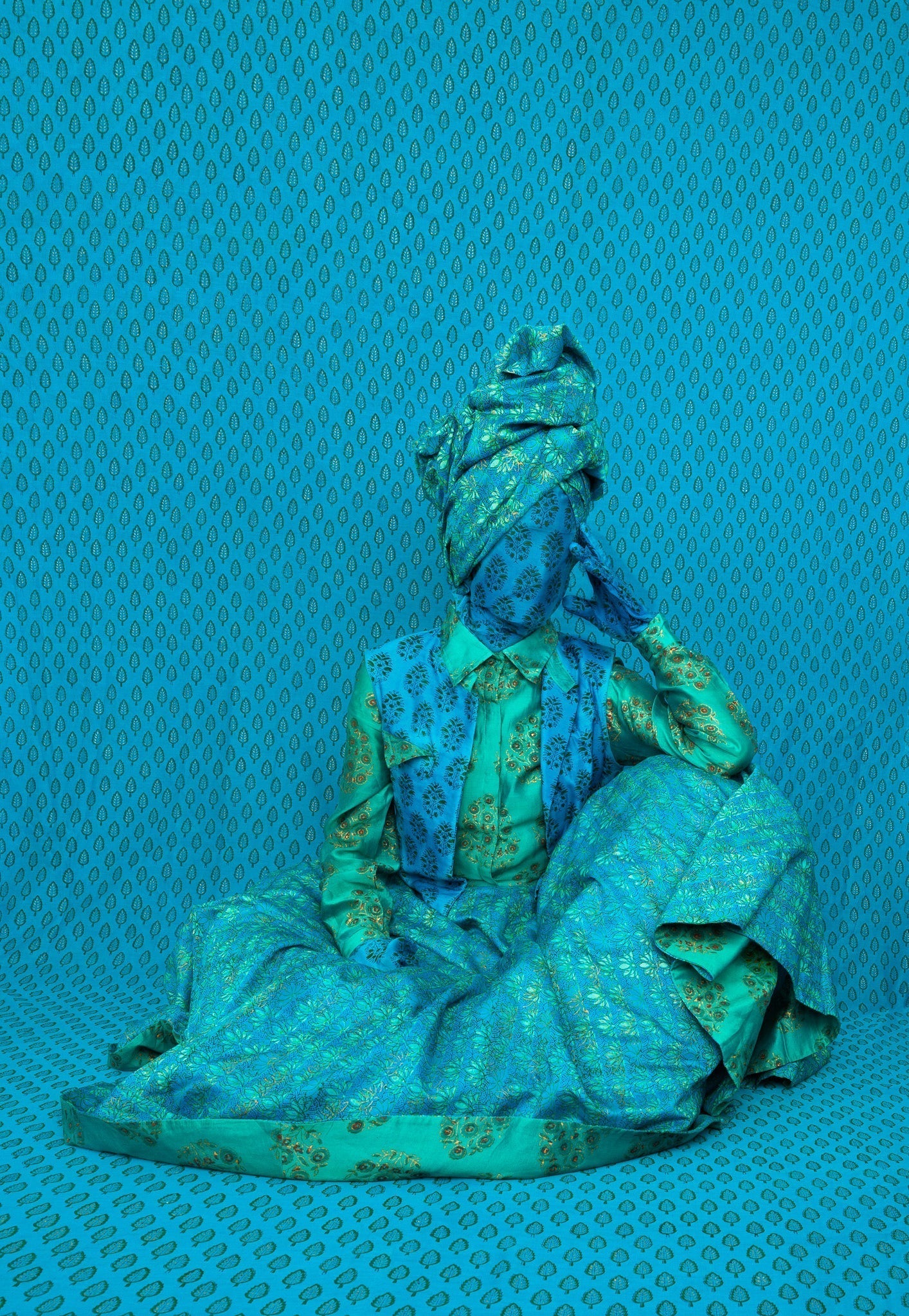
There is a particular stillness in an image by Alia Ali, a stillness that feels less like calm and more like suspension. A figure stands before you, upright, composed, entirely present. And yet the face, that ancient guarantor of individuality, is gone. In its place: cloth. Pattern. A field of color so intricate it seems to vibrate.
At first glance, the photographs seduce. The textiles, indigo-drenched batiks, densely woven kanga, geometric Middle Eastern prints, wrap around the body with sculptural precision. The compositions are exacting, almost classical. Light moves across the surface of fabric the way it might across marble. One thinks, briefly, of fashion photography. Of portraiture. Of the long Western history of drapery as both revelation and concealment. But the longer you stand there, the more the image resists aesthetic containment.
Ali, who was born to Yemeni and Bosnian parents and has lived across multiple continents, has made a practice of interrogating visibility—who has it, who is denied it, and at what cost. In her series, the textile does not decorate the body; it displaces the face. Identity is not expressed through physiognomy but through pattern, through inherited material culture, through cloth that carries geography in its weave. The gesture is deceptively simple. Remove the face and you destabilize the viewer. The reflex to categorize, race, gender, emotion, is frustrated. You search for the eyes and find ornament. You look for expression and encounter history.

Textiles, in Ali’s work, are not props. They are archives. Many of the fabrics she uses are charged with colonial histories, trade routes, and political symbolism. Some patterns were industrially produced in Europe and sold back to African markets, becoming, over time, absorbed into local identity. Others are bound to ritual, to gendered labor, to community. In wrapping her subjects entirely—face included—Ali stages a quiet confrontation between surface and depth. What appears decorative becomes declarative.
There is something radical in her refusal to offer the face as proof of humanity. Western portraiture, after all, has long equated the face with individuality, with interiority, with the soul. To obscure it is to risk dehumanization. Yet in Ali’s images, the opposite occurs. The concealment feels protective, even defiant. The body stands firm. The gaze, though invisible, feels returned.
Her practice sits at the intersection of photography, performance, and sculpture. The figures are meticulously staged, often positioned against backgrounds that either harmonize with or sharply oppose the textile’s pattern. The effect can be disorienting: a body dissolving into geometry, or emerging from it like a newly formed monument. The photographs are large, immersive. One does not merely view them; one stands before them, aware of one’s own act of looking.

And looking is central here. Ali’s work engages what theorists have long called the politics of the gaze. Who is allowed to look freely? Who is scrutinized? Who becomes spectacle? By withholding the face, she unsettles the asymmetry between viewer and subject. The expected intimacy of portraiture is denied. Instead, the viewer must confront their own expectations, about transparency, about access, about entitlement.
There is also pleasure. This is important. The works are beautiful, undeniably, insistently so. The colors saturate the eye. The symmetry soothes. Ali understands seduction as strategy. Beauty draws you in; complexity keeps you there.
In a culture obsessed with exposure, selfies, surveillance, the constant offering of the face as currency, Alia Ali proposes an alternative. Identity need not be legible to be real. Visibility need not mean vulnerability. And sometimes, the most powerful portrait is the one that refuses to show you what you think you are entitled to see.